
Learning to Disagree
“Your reflections are maddening to me,” Kerry Cunningham to Joe Leininger.

When a friend of forty years has a critique, you’d be a fool not to lean in: “I find the idea of a good and loving God offensive in light of the evil and suffering in the world. And that’s where most of your stories end up.”
Kerry’s observations were right, of course. I write about what I have experienced. And the most surprising experience of my life is a belief that God is bigger and better than what I previously imagined. My friend believes in no such thing.
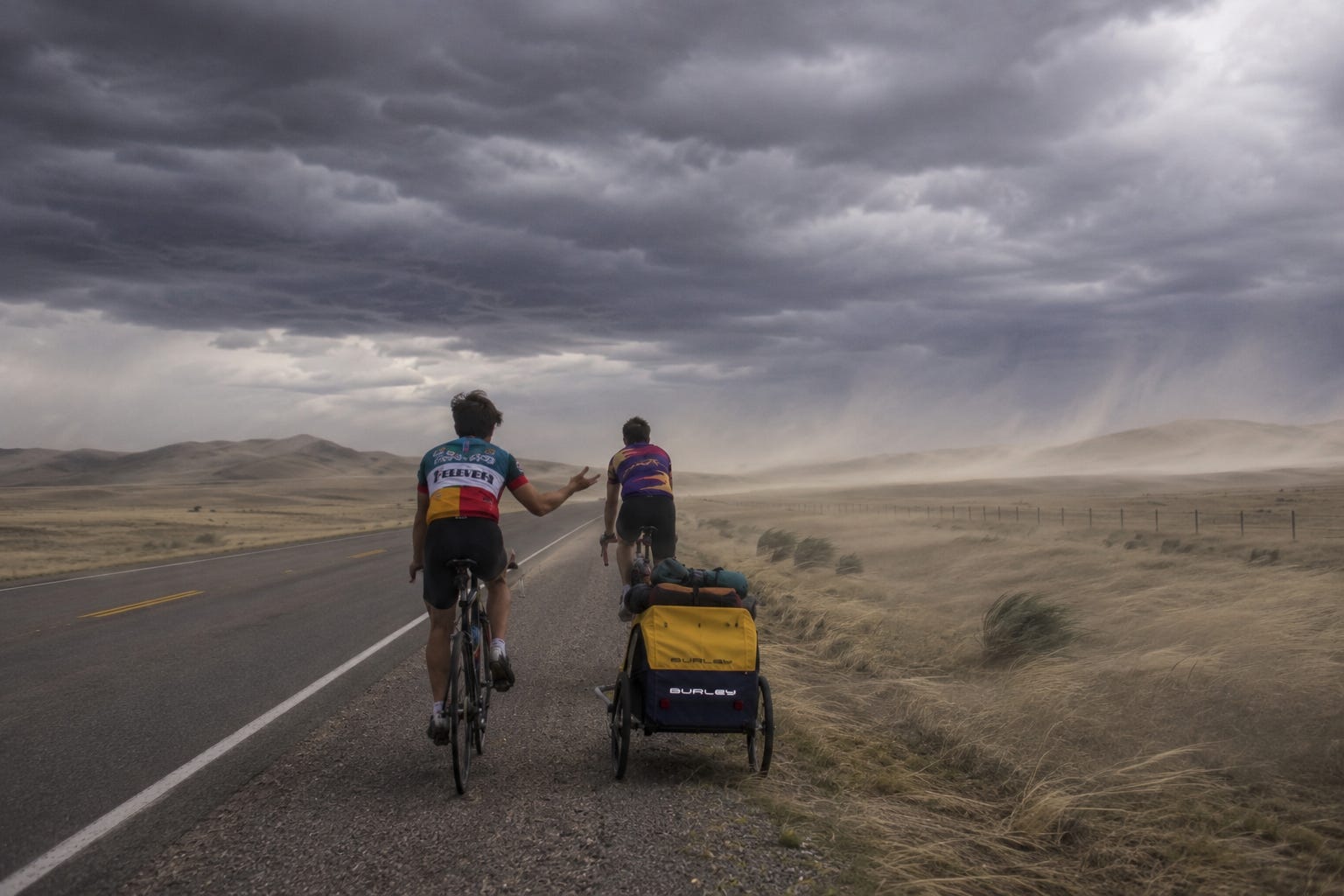
We’ve been friends since college, and years ago, we rode bikes across the country together. You get to know someone pretty well riding 100 miles a day for five weeks. To kill the time, we talked about baseball, faith, books, and our futures, while laughing constantly as an antidote to the trip’s inevitable inconveniences.
After we finished, we lost touch for nearly 20 years. During that time, he became an atheist and I fell more deeply in love with God, both of us staking our positions with conviction and gusto. When we reconnected, we learned to tread carefully around matters of faith, and reestablished our friendship around the Red Sox and Cubs, with deviations into lesser themes like timeless literature and the state of the world. Every now and then, we still mix it up. He’s a scrapper from New England and I have combative instincts honed on the trading floor. We can’t help ourselves.
Anyway, my friend and I see the world differently. Maybe Kerry should stop reading my writing and I should ignore his critiques. That way, he doesn’t get frustrated and I don’t get hurt. Isn’t that the way to handle differences these days? Deal with conflicts by avoiding them altogether and eliminating those who disagree with us as we retreat back to be with those who share our worldview. Have I got that about right?
A democracy is built on a belief that we can maintain civility towards those we disagree with and the Kingdom of God is underpinned with a commitment to love friends, enemies, and everything in between. Neither one functions when we ignore, insult, or fight with those who disagree with us. How we disagree matters deeply.
Although I am flattered that my atheist friend would read my reflections, I bruise easily and would have preferred to hear that he was encouraged by my writing rather than infuriated by it. I have this illusion that if I tell a good story, the world will become a slightly better place. I know, it’s nuts, but in my mind, this happens when we encounter God’s love and learn to love others better as a result. Of course, it’s presumptuous, but if it could happen to me, why not for others as well.
Solving for the theodicy—how suffering can exist under the domain of a good and powerful God—is a great discussion for real friends. Looking back, it seems that I anticipated Kerry’s position on the theodicy when I shook my fist at the sky for the fierce headwinds of Central Montana, asking in colorful language, “How could a loving God torture us with this wind?” Although it was small “s” suffering, I was serious as a snakebite, and didn’t consider it an inconsequential inquiry at the time. Friends see us at our rawest selves. There’s grace for me in remembering that neither one of us have ever settled for easy answers to life’s hard questions.
I hope Kerry and I get better at understanding what makes life full and purposeful for each of us. To do this, we’ll need to listen better and talk less, perhaps a template for a world that is insistent on being heard, without any corresponding interest
in understanding those on the other side. This is hard stuff. The Founding Fathers struggled to do that with each other even as they wrote the noble words that formed our republic.
If Kerry and I don’t succeed in modeling a path forward to save our republic, I will settle for becoming a better friend. Hey, it seems that my writing is making a difference after all.